

Your AI Isn't Broken. Your Workflows Are

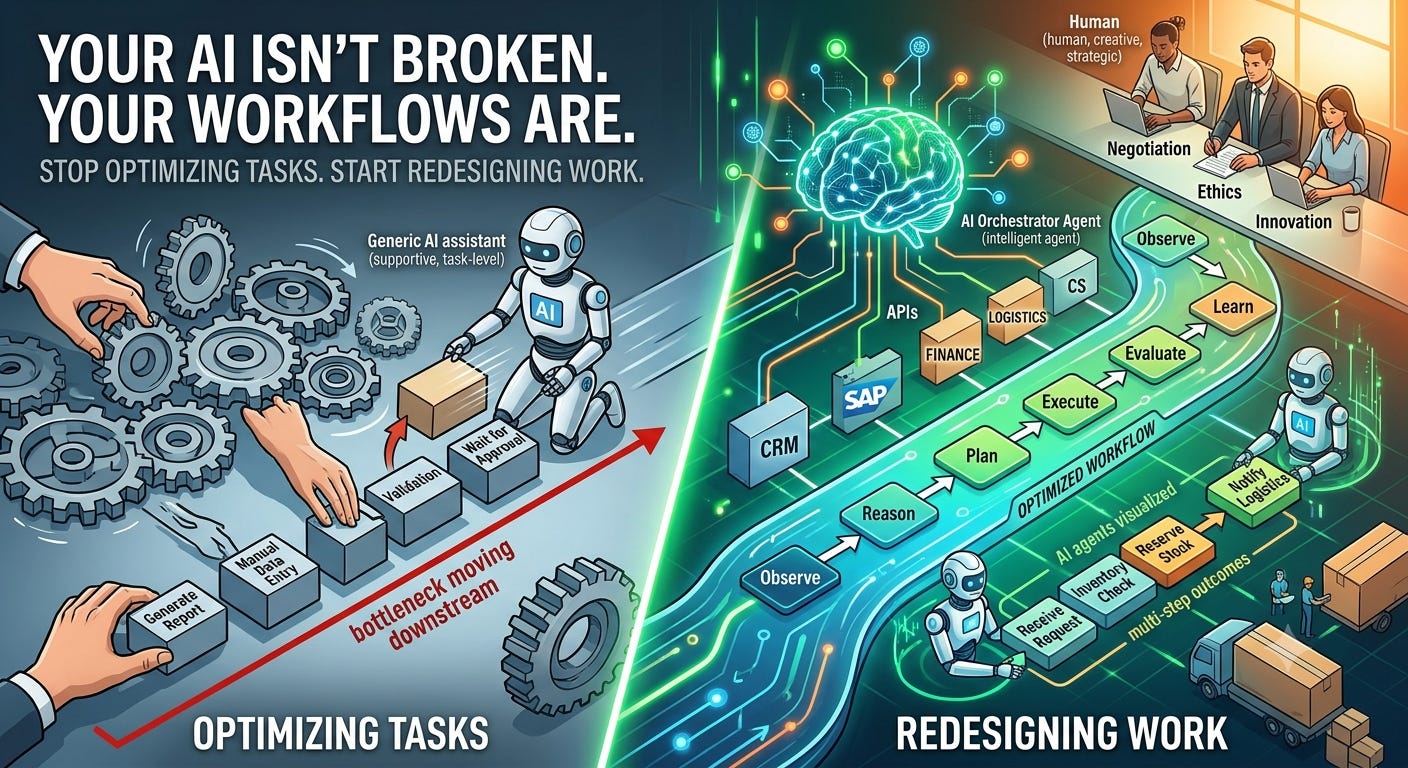
Most organizations think their AI initiatives fail because the models are not good enough but in reality they are solving the wrong problem.
The biggest obstacle to AI productivity is rarely the AI itself. It is the workflow surrounding it.
Adding AI to a broken process usually means the same broken process runs faster. The bottleneck simply moves downstream.
The organizations creating measurable business value understand something fundamentally different. They are not asking how AI can perform individual tasks more efficiently. They are redesigning entire workflows around what AI can do autonomously.
That shift separates companies experimenting with AI from companies building a competitive advantage.
The AI Productivity Trap
Most AI projects begin with the same question:
“How can AI make this task faster?”
It sounds reasonable.
It is also the wrong question.
Imagine a financial analyst who spends thirty minutes every morning preparing a report before manually entering the numbers into SAP.
Generative AI reduces the report creation time from thirty minutes to five.
Success?
Not really.
The analyst still has to log into SAP, copy the information, validate exceptions, wait for approvals. The workflow remains unchanged.
The work simply arrives at the next bottleneck twenty-five minutes earlier.
Local optimization rarely produces systemic transformation.
Research consistently shows that improving an individual task can generate impressive efficiency gains, while the overall business process changes very little because every downstream dependency remains intact.
Real productivity comes from redesigning the workflow itself.
Productivity Isn’t About Faster Tasks. It’s About Shorter Workflows
This distinction changes everything.
Traditional organizations measure success using metrics such as:
Time saved per task
Faster document creation
Reduced response time
More reports generated
AI-native organizations measure something completely different:
End-to-end workflow duration
Decision velocity
Number of human handoffs removed
Percentage of work completed autonomously
Those metrics determine business performance and not typing speed nor proompt quality.
The Hidden Cost of Human Glue
Most organizations have a role nobody officially recognizes that I call Human glue.
These are the people who spend their day moving information between disconnected systems: CRM; Excel; ERP; Email; Ticketing platforms; Legacy applications.
Each transfer often requires someone to copy, validate or reformat information before sending it somewhere else.
They are not creating value.
They are keeping disconnected systems alive.
Imagine a customer onboarding process:
Sales closes a deal
Operations receives an email
Finance creates an invoice
Legal prepares documentation
IT provisions user access
Customer Success schedules onboarding.
Each department waits for the previous one.
Each transfer introduces delays.
Each delay creates uncertainty.
Each uncertainty requires another meeting.
This is where agentic AI changes the equation. Instead of accelerating each individual step, AI becomes the bridge connecting them.
Humans stop acting as middleware and start focusing on exceptions, negotiation, judgment and innovation.
AI does not replace expertise.
It replaces that glue.
The Shift from Generative AI to Agentic AI
Generative AI answers questions while Agentic AI completes work.
That difference is larger than most organizations realize.
A traditional AI assistant might draft an email.
An AI agent can:
Receive a customer request
Verify customer identity
Check inventory
Reserve stock
Update the CRM
Trigger billing
Notify logistics
Escalate only if confidence drops below a predefined threshold
Instead of supporting one task, it owns an entire business outcome.
The transition is no longer about generating information.
It is about generating action.
How Agentic Systems Actually Work
Every agent follows a continuous operational loop.
Observe - Collect information from systems, documents and events.
Reason - Interpret context and determine the appropriate objective.
Plan - Create a sequence of actions.
Execute - Interact with enterprise applications through APIs, tools and workflows.
Evaluate - Measure confidence, verify outcomes and detect failures.
Learn - Improve future decisions using feedback and evaluation systems.
Unlike traditional automation, this process is adaptive rather than predefined.
AI Maturity Isn’t About Better Models
Organizations typically evolve through predictable stages.
Level 1 — Task Automation
AI accelerates isolated activities.
Writing
Summarization
Translation
Classification
Level 2 — AI Assistance
Humans remain responsible while AI supports execution.
Level 3 — AI Agents
Individual agents complete multi-step business processes autonomously.
Level 4 — Multi-Agent Collaboration
Specialized agents cooperate across departments.
Sales
Finance
Operations
Customer Support
Engineering
Level 5 — Enterprise Orchestration
The organization no longer manages isolated AI systems.
It manages an intelligent operating model where people, agents, data and workflows continuously coordinate business execution.
This is where real enterprise transformation begins.
Parallel Work Replaces Sequential Work
Traditional organizations work sequentially.
Research
Design
Development
Testing
Deployment
Each stage waits for the previous one.
Agentic organizations think differently. Multiple AI agents explore different solutions simultaneously. One investigates customer requirements, the other generates alternative product concepts, a third one evaluates technical feasibility and finally the last one estimates costs.
Instead of reviewing one prototype, leadership reviews four.
The organization compresses weeks of exploration into hours.
The Real Competitive Advantage: Decision Velocity
Most executives believe AI is about operational efficiency.
In my opinion is increasingly becoming a decision advantage.
Organizations compete through the speed and quality of decisions.
Faster decisions shorten product cycles which accelerate customer responses, reducing operational uncertainty and increasing organizational adaptability.
AI becomes the coordination layer that continuously feeds better decisions into the business.
The trend is companies competing less on productivity and more on decision velocity.
Three Leadership Mistakes That Kill AI ROI
Mistake 1
Buying AI before redesigning work.
Technology cannot compensate for broken processes.
Mistake 2
Measuring task productivity instead of workflow performance.
Saving twenty minutes means little if approvals still require two weeks.
Mistake 3
Treating AI as software instead of digital labor.
Software waits for instructions but an Agent pursue objectives.
Managing those two technologies requires completely different leadership approaches.
Orchestration Is Becoming the New Management Discipline
As organizations deploy dozens or hundreds of AI agents, coordination becomes more important than automation.
Traditional coordination depends on meetings, committees, status updates and a lot of consensus.
Enterprise orchestration operates differently:
Resources move dynamically
Priorities change continuously
Agents collaborate automatically
Human leaders intervene only when strategic judgment is required
This demands an entirely new operating model built around five capabilities:
Shared enterprise data
Agent orchestration
Governance
AI evaluation systems
Human oversight
Together, these form the enterprise intelligence layer.
Without it, organizations simply create isolated AI islands.
The Human Role Doesn’t Disappear
The human role continues to be needed but it moves from as routine execution increasingly belongs to AI.
Human contribution shifts toward areas where uncertainty remains high.
Strategic thinking
Negotiation
Creativity
Ethics
Complex judgment
Relationship building
Innovation
The future is not humans competing against AI
It is humans deciding where judgment creates the highest value.
The Blueprint for AI Productivity
Organizations that consistently generate AI ROI tend to follow the same sequence.
Step 1 - Map the complete workflow.
Step 2 - Identify every point where humans only transfer information.
Step 3 - Replace those handoffs with autonomous agents.
Step 4 - Allow specialized agents to collaborate across departments.
Step 5 - Keep humans responsible only for decisions requiring judgment.
Step 6 - Measure workflow throughput instead of task efficiency.
Step 7 - Continuously evaluate, redesign and improve the system.
AI transformation is not a one-time implementation. It is more an operating capability.
Conclusion
In the coming years, every organization will have access to powerful AI models and that will no longer be the differentiator.
The winners will redesign how work flows through the enterprise which will remove the human glue that I spoke in the beginning of this article.
They will orchestrate digital coworkers instead of coordinating isolated software tools.
They will measure business outcomes instead of isolated productivity gains.
AI is not becoming another software category.
It is becoming the operating system for enterprise execution.
The Companies that recognize this shift will not simply work faster. They will build organizations that learn faster, decide faster and adapt faster than their competitors, because the future of AI is not about better prompts. It is about better systems.
An interesting perspective. Ironically, one of the biggest risks may be that people start using AI for exactly the capabilities you argue should remain human: judgment, creativity, ethics, and critical thinking. If that happens, the challenge won't be redesigning workflows alone, but preserving the human capacities that make those workflows worth redesigning in the first place.
The "human glue" people usually knew more about how the business actually worked than anyone above them. Watching the CRM talk to the ERP taught them where every process actually broke. Remove that role and the friction disappears, but so does the only job where junior people learned the business end to end. No one is redesigning that part yet.