

NotebookLM is becoming something ChatGPT and Claude were never designed to be

Most discussions about NotebookLM’s latest update focus on the new capabilities Google has introduced. People are understandably excited by the possibility of generating spreadsheets, presentations, reports, and other deliverables directly from source material. While those features are impressive, they are not what makes this update significant.
The more interesting story is that Google appears to be transforming NotebookLM from a document analysis tool into a knowledge work platform. Viewed from that perspective, the comparison with ChatGPT, Claude, Gemini, or Perplexity becomes less about features and more about philosophy. These products are increasingly solving different problems, even when some of their capabilities overlap.
For the past year, most AI tools have competed on intelligence, reasoning, and conversational ability. NotebookLM is moving in a different direction. Google is attempting to build an environment where information is collected, analyzed, transformed, and eventually turned into action. That shift has important implications for professionals, researchers, students, consultants, and anyone whose daily work depends on large amounts of information.
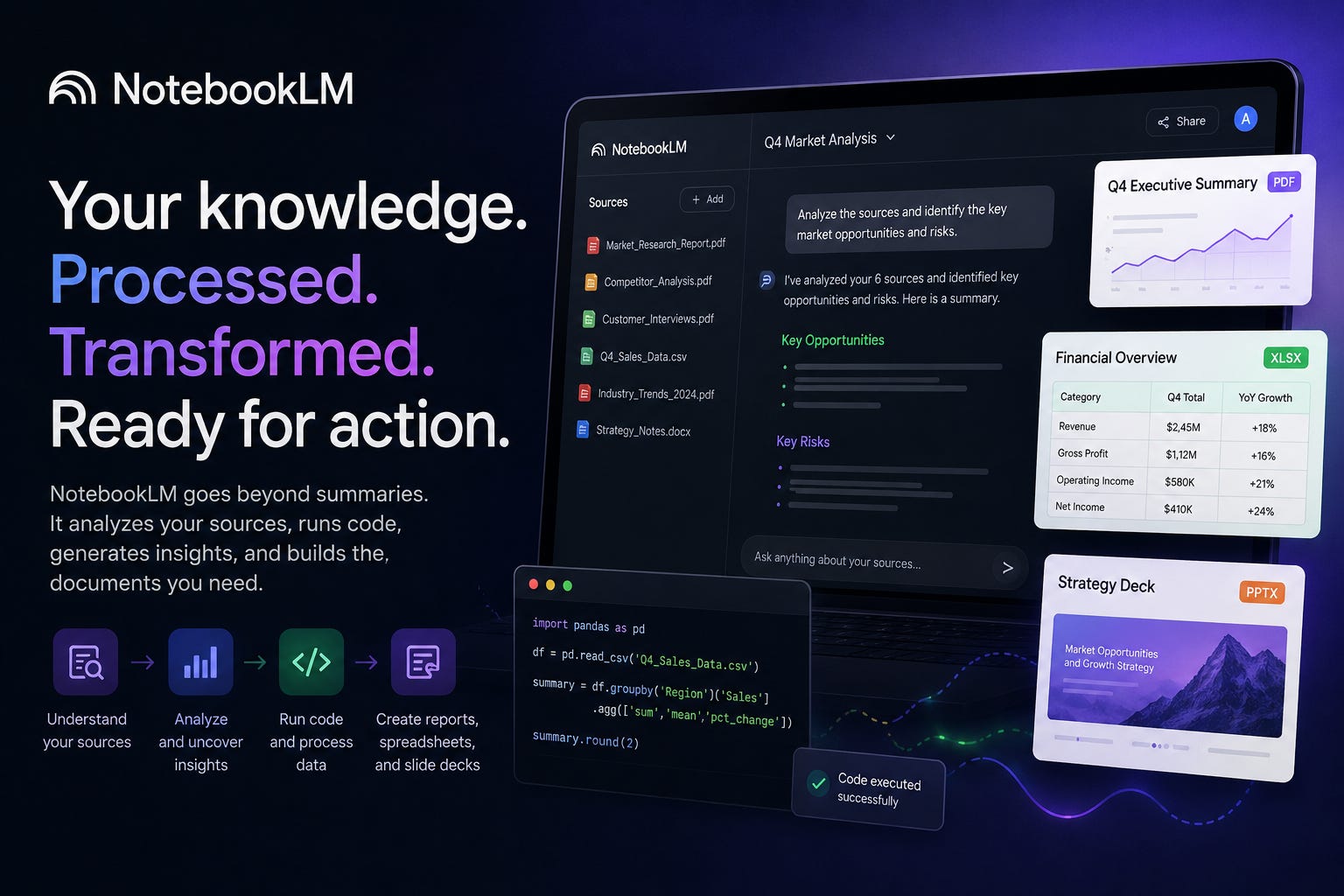
The evolution of NotebookLM
When NotebookLM first appeared, many people viewed it as a specialized research assistant. Users could upload documents, ask questions about them, generate summaries, create study guides, and explore connections between different sources. Those capabilities made it one of the most useful AI products available, particularly for people dealing with large volumes of information.
The limitation was that NotebookLM remained largely focused on understanding information rather than acting upon it.
A consultant could upload dozens of client documents and obtain an excellent summary of the situation.
A project manager could analyze project notes and identify key themes.
A student could transform research papers into learning materials. In every case, however, there was still a considerable amount of work required after the analysis phase ended.
The information had been organized and clarified, but the user still needed to build the spreadsheet, create the presentation, write the report, or develop the plan.
The latest update begins to close that gap.
By combining more advanced reasoning capabilities with a secure cloud-based execution environment, NotebookLM can now perform tasks that extend beyond summarization and retrieval. It can generate structured outputs, analyze datasets, perform calculations, create reports, and assist with the production of deliverables that traditionally required several separate applications.
The practical result is that NotebookLM is becoming less of a repository for knowledge and more of a workspace where knowledge is transformed into useful outputs.
Why this matters for business professionals
Most professionals do not suffer from a lack of information. They’re normally stuck with excess, that they are not able to handle.
Executives receive reports, dashboards, presentations, customer feedback, market intelligence and internal updates at a pace that makes comprehensive review almost impossible.
Project managers handle meeting notes, timelines, budgets, dependencies and stakeholder communications.
Consultants, analysts, and researchers often spend more time organizing information than extracting value from it.
This is where NotebookLM becomes particularly interesting.
Imagine a leadership team preparing for a quarterly review. The organization may have hundreds of pages of reports distributed across finance, operations, customer success, sales and product teams. Instead of manually reviewing every document, a manager could upload the entire collection and request a briefing that identifies the most important opportunities, risks, and decisions requiring attention.
A project manager could upload meeting transcripts, status reports, project plans, and budget updates, then ask NotebookLM to identify bottlenecks, unresolved dependencies and scheduling conflicts while generating a revised project tracker.
A consultant preparing for a client workshop could combine interview transcripts, research reports, survey responses, and internal documentation into a single notebook. Rather than spending hours assembling insights manually, the consultant could request a structured analysis highlighting recurring themes, strategic risks and recommended actions.
The value in each of these examples is not that the AI produces text. Every modern AI tool can produce text. The value comes from reducing the distance between raw information and decision-ready outputs.
Practical applications for individuals
The benefits are not limited to corporate environments.
